← Permanent-wave history: overview and related inventions
Two United States patents, granted less than two years apart, illustrate different directions of innovation. Josef Mayer focused on the relationship between a wound strand of hair and its heater. Marjorie Stewart Joyner addressed the arrangement and support of multiple heated devices around the head.
Reading guide. The patents establish two distinct engineering proposals. This page compares the problems addressed, the apparatus disclosed and the limits of the surviving evidence. It does not claim that one inventor copied the other or that either patent proves commercial success.
US 1,619,794 · 1 March 1927
Josef Mayer
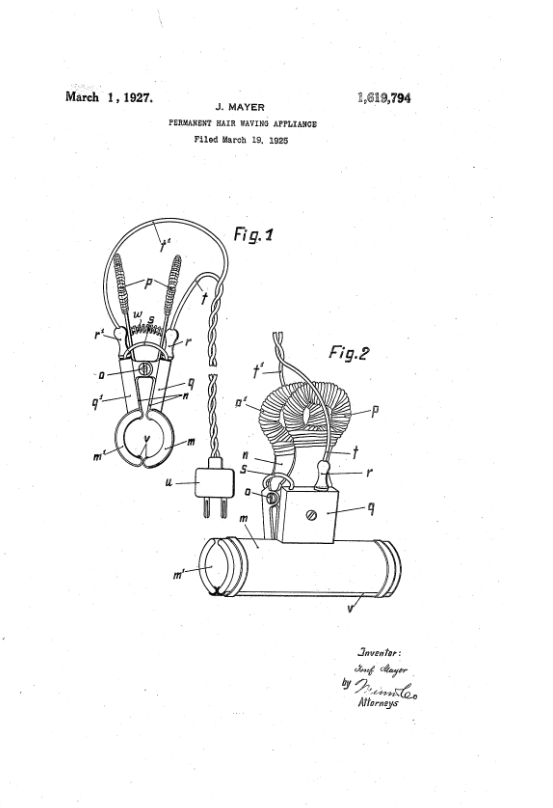
Patent illustration: Josef Mayer, US 1,619,794 (1927). Local archival image. Read the patent specification and claims.
Central question: How can a heating device be applied to hair wound in a relatively flat arrangement?
The patent documents an appliance with parts that open laterally to surround the wound strand. This is primarily a question of heater geometry and handling.
US 1,693,515 · 27 November 1928
Marjorie Stewart Joyner

Joyner patent-related illustration, Wikimedia Commons file Joyner1.gif. Verify image provenance and licence at the linked file page. Read the original patent.
Central question: How can several heated implements be positioned and supported during a treatment?
Joyner's patent describes a supporting arrangement for electrically heated curling devices, including protective features. This is primarily a question of apparatus organisation, suspension and practical operation.
What actually differs?
| Technical question | Josef Mayer | Marjorie Stewart Joyner |
|---|
| Focus | Heater fitted to wound hair | Support and positioning of multiple heating implements |
| Scale | Individual wound strand and its heating appliance | Overall arrangement of implements around the client's head |
| Engineering problem | Opening, closing and applying heat around the wound strand | Suspension, access and protection during a multi-implement treatment |
| Documented basis | US patent 1,619,794 | US patent 1,693,515 |
| What the patent alone cannot establish | Commercial adoption or superiority over competing heaters | Extent of salon use or superiority over other support systems |
Why this comparison matters
The two patents should not be presented as consecutive versions of the same machine. They address different parts of the permanent-wave procedure. A historical development tree is therefore more accurate when it shows parallel technical challenges rather than a simple ladder from one inventor to the next.
Evidence standard: Patent drawings and claims demonstrate what was disclosed and claimed at the time. They do not, without additional contemporary records, prove that an apparatus was manufactured in large numbers, adopted widely, or derived directly from another inventor's work.
Patent chronology: filing is not the same as grant
| Inventor | Application filed | Patent issued | Primary source |
|---|
| Josef Mayer | 19 March 1925 | 1 March 1927 | US 1,619,794 |
| Marjorie Stewart Joyner | 16 May 1926 | 27 November 1928 | US 1,693,515 |
Dates refer to the US patent records. Filing, publication, patent grant, manufacture and salon use are different historical events.
What the drawings can — and cannot — tell us
Mayer: heater and wound strand
The drawings show how an appliance can be opened and brought around hair prepared for treatment. The key historical question is the relationship between winding geometry and heater construction. The patent should be read for its precise claims; it does not by itself establish who first used flat winding.
Joyner: supporting multiple implements
The drawings and description concern the positioning and suspension of several heated curling implements, together with protective arrangements. This differs from a claim to invent permanent waving itself. The drawings cannot independently establish how many such machines were produced.
Evidence still needed
To move beyond a patent-based comparison, the research needs dated equipment catalogues, advertisements with identifiable models, contemporary trade-journal reports, photographs of installations, training manuals and, where available, company or sales records. Each should be linked to the specific claim it supports.
Open question: Were these patented designs manufactured in the forms illustrated, and where can their use in working salons be independently documented?
