Four major questions across time
How could heated implements produce a shaped wave, even if it was temporary?
How could winding, heat and chemical preparation work together in the salon?
How could different winding methods, heaters and supports make treatment more practical?
How could chemical reactions reduce dependence on large external heating systems?
Which inventions were patented, manufactured, advertised, taught and actually used?
How do heated rods and electronic control combine with chemical treatment today?
There was never just one invention
The permanent wave emerged through different approaches to shaping hair, applying heat, developing chemical treatments and making salon equipment practical. An inventor’s patent, a company’s machine and a widely adopted technique are not the same historical claim.
Marcel Grateau
Heated tongs produced a temporary wave. This important precursor must be distinguished from later lasting, chemically assisted treatments.
Explore the pioneers →Karl Ludwig (Charles) Nessler
His early permanent-waving process combined winding, chemical preparation and heat. The London demonstration of 1906 is a central milestone.
Nessler and the early process →Winding methods and Josef Mayer
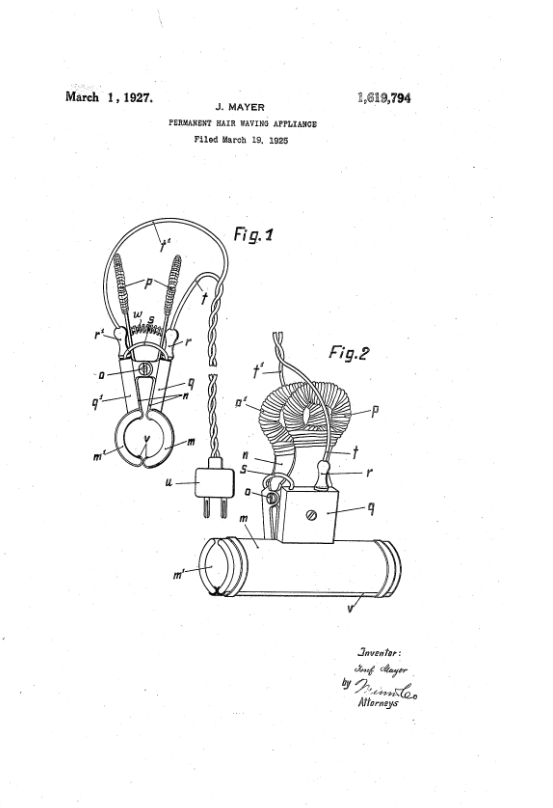
Different winding geometries posed new challenges for heating devices. Mayer’s US patent 1,619,794 describes a specific appliance arrangement.
Winding and patented apparatus →Marjorie Stewart Joyner
Her 1928 patent addressed the arrangement and support of multiple heated irons. It solved a different design problem from Mayer’s appliance.
Compare the patents →Chemical cold waving
Chemical treatments created another pathway, reducing dependence on the large heated machines associated with earlier systems.
Chemical cold-wave history →Later and digital systems
Electronically controlled heated rods and chemical treatments invite technical comparison, but similarity alone does not prove direct descent.
Modern systems →Read the inventions in their original drawings
Patent drawings allow us to examine the arrangement of parts rather than relying only on later retellings. Two inventions from the 1920s illustrate why the history cannot be reduced to a single machine.
Marjorie Stewart Joyner, 1928
Joyner's patent focuses on the support and positioning of multiple heated implements. Its mechanical arrangement should be assessed independently from Mayer's appliance.
View Joyner's original drawings and patent claims →
See the side-by-side technical comparison →
US 1,693,515 · granted 27 November 1928
Not all inventions answered the same question
| Approach | Primary technical question | Evidence to examine |
|---|---|---|
| Marcel-type heated tongs | How can hair be shaped temporarily by heat? | Contemporary trade sources and surviving tools |
| Nessler's early process | How can a wave persist after treatment? | Demonstrations, patents and trade reports |
| Winding and heaters | How can differently wound hair be heated? | Patents, apparatus drawings and manuals |
| Support structures | How can multiple heated devices be positioned? | Patent claims and machine photographs |
| Chemical cold waving | How can lasting reshaping rely less on external heat? | Chemical patents, manuals and dated advertisements |
| Modern digital systems | How can chemical treatment and controlled heating be combined? | Manufacturer specifications and professional instructions |
How to use this research
Start with the historical overview, follow the relevant specialist chapter, and consult the primary document. Distinguish patent date, public demonstration, manufacture and commercial adoption; these are different kinds of evidence. Where attribution or influence remains unproven, the research register identifies the gap.
Go deeper
Innovation Atlas · Development Tree · Technology & Patents · Evidence Register
Beyond the permanent wave
Permanent waving is one chapter of hairdressing history. Explore the tools of the profession, inventors and pioneers, and historical trade journals and professional networks.