Where does winding begin?
Root-first and end-first winding produce different arrangements of the hair on the rod. The terms must be checked against contemporary training manuals.
How the geometry of winding changed permanent waving
Two original patents, two different engineering problems: heater geometry versus machine support.
Explore the illustrated patent comparison →Research status: the distinction between documented patent claims, technical interpretation and unresolved questions is intentional. A named system is not automatically evidence of a unique invention.
Hair length, the diameter of the curl and the distance from the scalp affected the suitability of a procedure. Different winding patterns required compatible clamps, heaters and handling methods.
Croquignole winding wraps hair from the ends toward the scalp. The method is not automatically attributable to one inventor: priority, naming and commercial spread need separate evidence.
Josef Mayer’s US Patent 1,619,794 (filed 19 March 1925, granted 1 March 1927) describes a heating appliance suited to flat-wound hair. Its lateral-opening heated shells address the practical problem of fitting a heater around the curler.
The comparison should distinguish a winding method from the apparatus designed to work with it. A patented heater is not, by itself, proof that its inventor originated the entire winding technique.
Root-first and end-first winding produce different arrangements of the hair on the rod. The terms must be checked against contemporary training manuals.
A spiral distribution along a rod is not the same as layers of hair wrapped around one another. This affects the relationship between rod, hair and heater.
The heater must fit the resulting package of hair. Winding geometry and heating-appliance design therefore developed as connected technical problems.
| Approach | Technical arrangement | Historical question |
|---|---|---|
| Spiral winding | Hair is distributed helically along a rod; early permanent-wave practice used forms of spiral winding. | Which specific rod, clamps and heaters were used in each documented system? |
| Croquignole winding | Hair is rolled from the ends towards the scalp, with successive layers accumulating around the rod. | When did the term enter trade usage, and how did methods differ between salons? |
| Flat winding and associated heaters | A flattened wound arrangement may require a heater capable of opening laterally around the hair package. | What precisely is claimed in Josef Mayer’s patent, and what was already known? |
These are comparative descriptions, not a claim that each method was invented by a single named person or appeared at one precise date.
Mayer’s patent, filed on 19 March 1925 and issued on 1 March 1927, provides a concrete way to study the interaction between a winding arrangement and the appliance used to heat it. The patent drawings illustrate the construction described in the specification. Read the claims to determine the legally asserted invention; do not infer production numbers or salon adoption from the grant alone.
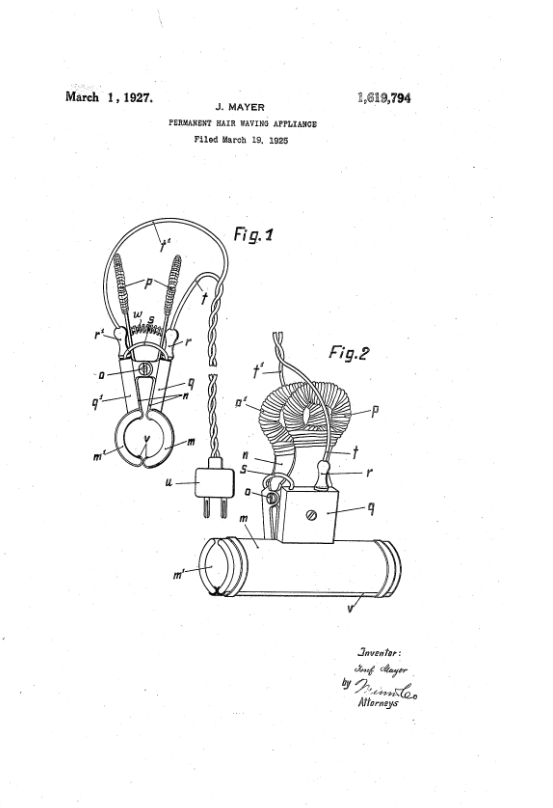
A method of arranging hair, a tool for holding it and a patented heating appliance are three different kinds of historical evidence. Advertising may show a marketed product; a patent may describe a proposal; a photograph may document one installed machine. The most reliable reconstruction combines all three without treating them as interchangeable.
See our evidence register → · Return to the innovation atlas →