Explore the history of hairdressing through its technical problems, inventors and surviving evidence. Marcel Grateau’s heated tongs, Nessler’s permanent-wave process, Mayer’s heater, Joyner’s machine arrangement and chemical cold waving belong to different — sometimes overlapping — lines of innovation.
Research standard: A patent documents a claimed invention, not necessarily a manufactured or commercially successful machine. Similar designs do not by themselves establish direct influence.
The history of hairdressing is also a history of technical experimentation. Heating, shaping, drying and treating hair required tools, materials, skilled operators and systems for teaching new methods. Patents offer valuable evidence, but they are only one part of the story.
From technique to apparatus
The transition from manual curling and heated implements to increasingly elaborate permanent-wave apparatus was not a single invention. Different practitioners and manufacturers developed competing approaches, improved components and adapted techniques to salon conditions.
Reading patents critically
A patent can document an inventor’s technical proposal and its claimed novelty. It does not, by itself, establish commercial production, widespread use or priority over every earlier practice.
Research themes
Heating and temperature control: the challenge of applying heat consistently while protecting hair and scalp.
Waving and setting: winding methods, clamps, rollers and their interaction with hair preparations.
Salon equipment: the practical organisation of machines, electrical supply and operator training.
Patent histories: national filings, later improvements, manufacturers and commercial names.
People, inventions and evidence
Karl Ludwig (Charles) Nessler is an important reference point for the development and international diffusion of permanent-wave technology. His life and documentary record are treated in detail by the separate Nessler Research Project.
The wider history also includes other inventors, practitioners and firms. Their technical contributions must be assessed against dated contemporary evidence rather than later promotional claims.
Useful primary sources include patent specifications, trade journals, advertisements, catalogues, instruction manuals and photographs of machines in actual salons.
A chronology of changing methods
1906 — London demonstration
Nessler’s London demonstration on 8 October 1906 is a key chronological reference for the early public presentation of his permanent-wave process. The event should be studied alongside contemporary trade reporting, rather than only through later retellings.
1909–1921 — Patenting and adaptation
Patent records in Switzerland, Britain, Germany and the United States trace a sequence of technical claims and adaptations. Examples under investigation include Swiss patent CH 49814 and US patent 1,400,370 (1921). A patent records a claimed invention, not proof of commercial manufacture.
1925–1927 — An American apparatus patent
The archival register records J. Mayer’s “Permanent Hair Waving Appliance”, US 1,619,794: filed 19 March 1925 and granted 1 March 1927. Its drawings offer a concrete starting point for comparison with other systems.
1928 onward — Industrial consolidation
The formation of Nestlé-LeMur in 1928 illustrates how the story extends beyond individual inventors to companies, product lines, distribution and salon training.
How to compare an apparatus
Mechanical arrangement
Identify the heating elements, clamps, winding direction, supports, insulation and points of contact with hair and scalp. Describe what the drawing actually shows before interpreting its function.
Claims versus practice
Compare the patent specification with advertisements, trade demonstrations, instruction manuals, photographs and surviving devices. A commercial product name should not be assigned unless a source supports it.
Safety and working conditions
Examine operating time, heat exposure, electrical infrastructure, operator training and the salon setting. Claims of safety or performance in period advertisements must be treated as promotional statements.
Open research questions
Which patented designs reached serial production, and under what commercial names?
How did salons adapt equipment to local electrical and safety conditions?
How did the relationships among inventors, manufacturers, demonstrators and training schools change over time?
Research status. This page is an introductory research overview, not a completed scholarly catalogue. Illustrations are design placeholders, not authenticated historical photographs or evidence. Specific claims will be documented with dated primary sources as the collection develops.
From heated tongs to cold waving: a documented timeline
1870s — Marcel Grateau. Heated-tong waving becomes a recognised styling method; the traditional dating of the innovation to 1872 should be treated as a historical attribution rather than a patent date.
1906 — Karl Ludwig Nessler. Public demonstration of his permanent-waving system in London. A pivotal documented moment in the history of electrically heated, chemically assisted hair waving.
1924–1927 — Josef Mayer. Flat-winding development and an electrically heated appliance designed to work around flat-wound hair. US 1,619,794 issued in 1927.
1928 — Marjorie Stewart Joyner. US 1,693,515 documents a suspended multi-iron permanent-waving machine; the original patent plates appear in the next dossier.
1930s–1940s — machine-less and cold-wave approaches. Chemical techniques increasingly reduced dependence on large electrically heated salon machines. Specific priority and commercial claims need individual patent and trade-publication checks.
Other names and systems identified in the project’s survey — Gallia, Szeemann, Suter, Calvete, Frederics, Racine and Willatt — remain in the research index. They will receive individual dated source records before detailed priority or performance claims are made.
TECHNICAL PREDECESSOR · LATE 19TH CENTURY
Marcel Grateau: thermal waves before the permanent wave
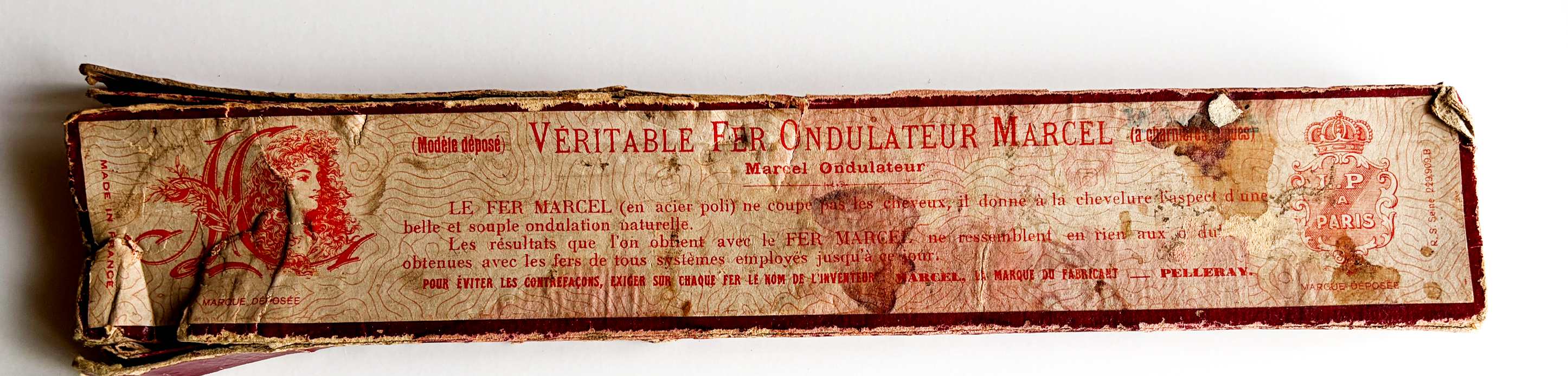
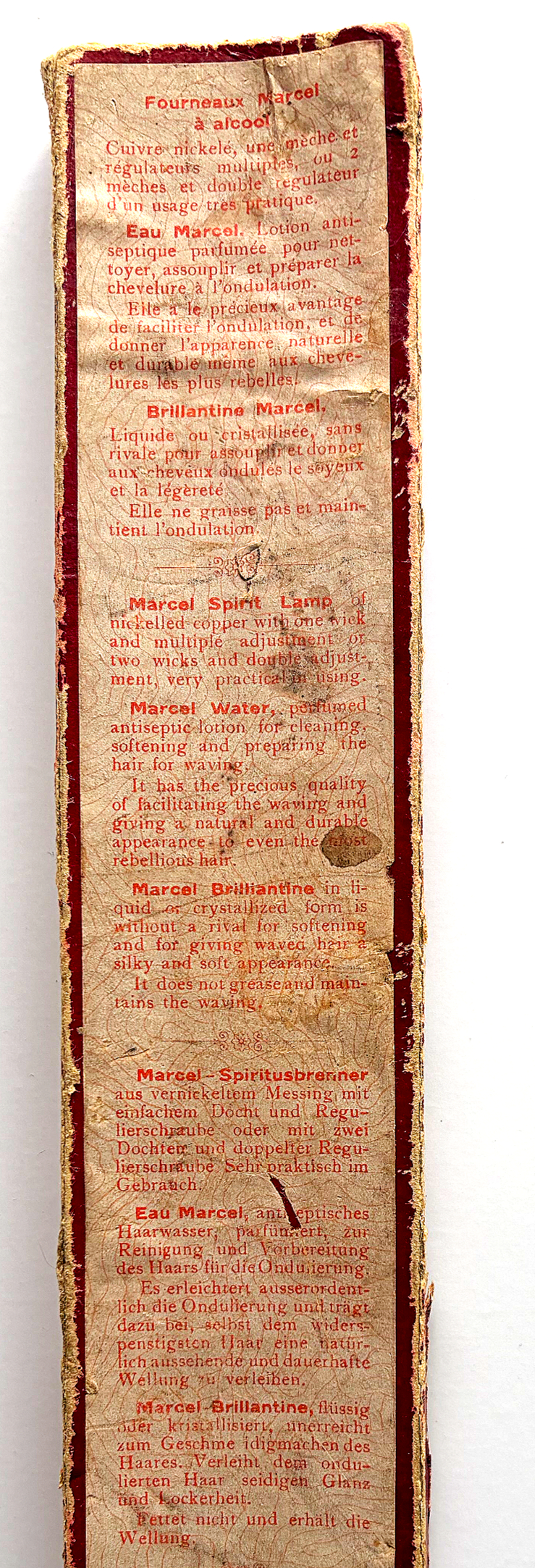
Historical object: front of packaging. Marcel ondulation iron. Photograph of a surviving historical package, reproduced from the project’s existing collection. Dating and manufacturer attribution require examination of the object.Reverse of packaging. Printed instructions and product information illustrate how a styling technique became a marketed object. Photograph of a surviving historical package, reproduced from the project’s existing collection. Dating and manufacturer attribution require examination of the object.
Marcel Grateau’s technique used heated tongs and controlled hand movements to produce sculpted waves. It was a skilled temporary thermal styling method: washing or moisture could undo the result. The later permanent wave involved additional chemical and mechanical processes intended to change the hair’s form for longer periods.
Why this distinction matters
Grateau belongs in a history of hair-waving technology, but the Marcel wave should not be presented as an early chemical permanent wave. Its historical importance lies in controlled heat, tool design, professional training and the market for specialised styling implements.
Object evidence: surviving packaging for a Marcel ondulation iron, from the existing research collection. The package can document advertising language and instructions; it does not independently establish the precise date when Grateau first developed the method.
PATENT DOSSIER · 1924–1927
Josef Mayer and the technical problem of flat winding
The shorter hairstyles of the 1920s changed what a permanent-wave machine had to accomplish. A spiral arrangement wound hair along a rod; in flat or croquignole winding, a section was rolled from the free end towards the scalp. That change created a practical engineering problem: how could a heater be fitted around a roller lying close to the head?
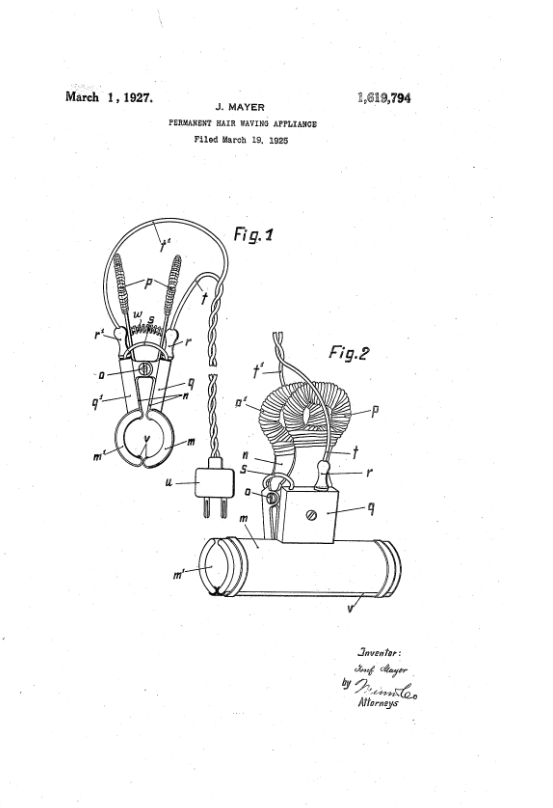
Original patent drawing. Josef Mayer, Permanent-Hair-Waving Appliance, US 1,619,794, issued 1 March 1927. United States Patent Office. Read the patent and claims.
What the patent actually describes
Josef Mayer’s US patent 1,619,794, filed on 19 March 1925 and granted on 1 March 1927, addresses this specific problem. Its paired, semicylindrical electrically heated bodies open with scissor-like handles, allowing the heater to be placed laterally around the wound hair rather than slid over the roller from one end. The specification also discusses removable insulating strips at the edges and the electrical connections.
Technique, invention and commercial claims
Mayer’s biography in the project’s earlier research places experiments with flat winding in 1923–1924. The US patent independently establishes the construction claimed in 1925 and published in 1927; it should not be used alone to prove that Mayer was the first person anywhere to employ every aspect of croquignole winding. Likewise, a patent drawing is not evidence of production volume or worldwide adoption.
Marjorie Stewart Joyner’s permanent-waving machine (1928)
Sheet 1. General arrangement of the permanent-waving machine. US Patent 1,693,515 (1928).Sheet 2. Construction details and components of the apparatus.Sheet 3. Additional technical drawings from the patent specification.
Images: United States Patent Office, US 1,693,515 (27 November 1928); scans hosted by Wikimedia Commons. Click a drawing for its source and reuse information. The original patent drawings are historical evidence, not reconstructions.
Marjorie Stewart Joyner applied for a US patent on 16 May 1928. Patent US 1,693,515, granted on 27 November 1928, describes a permanent-waving apparatus with a height-adjustable stand, overhead dome, electrically heated curling irons, supporting clamps and scalp protectors.
Construction and operation
The dome houses a removable spacing plate. Insulated wires connect the plate to several electric curling irons. Hooks on the dome support clamping devices, designed to carry the weight of the irons rather than leaving it entirely on the client's head. The drawings also illustrate how sections of hair were wrapped and protected during treatment.
What the patent does—and does not—show
The original specification explicitly presents the apparatus as suitable for different hair types. It demonstrates Joyner’s proposed construction and the functions she claimed. The patent alone cannot establish treatment-time savings, widespread sales or the number of machines built. Those questions require trade advertisements, manuals, catalogues or salon records.
Technical comparison
Joyner’s design can be examined alongside earlier permanent-wave systems associated with Karl Ludwig Nessler and the 1927 apparatus patent US 1,619,794 attributed to J. Mayer. A meaningful comparison should distinguish the arrangement of heaters, support structures, protective measures and individual patent claims, rather than suggesting that a single invention made the process commercially practical.
Permanent-waving systems: a comparative research catalogue
These entries distinguish verified patent evidence from working attributions in the project's existing research notes. A system name is not automatically a patent, a single machine model or proof of commercial distribution. The catalogue will expand as original documents are identified.
How to read this catalogue. “Patent documented” means an identifiable original patent is available. “Working attribution” means the name or description appears in our current research material but its technical details still require a dated primary source. This distinction is intentional: the history of hairdressing should not turn advertising language into verified engineering claims.
The Nessler system
c. 1905–1909 · London / Europe
Nessler combined winding under tension, chemical treatment and externally applied heat to produce a lasting change in hair shape. His public London demonstration of 1906 is a useful dated reference point; patents published in 1909 document subsequent apparatus designs. Do not confuse the date of early experiments, a demonstration and the date of a granted patent.
Evidence and limits: Early systems required considerable handling and exposed operators to practical challenges of heat, moisture, weight and scalp protection. The exact configuration varied over time.
A family of related heaters, supports, clamps and protective arrangements developed around early permanent waving. Changes should be reconstructed from dated patents, advertisements and surviving machines rather than treated as a single uniform model.
Evidence and limits: Claims of better temperature regulation or lighter equipment require a specific contemporary device and comparative evidence.
Gallia is recorded in the project’s working overview as an early European electric permanent-wave system associated with France. Its relationship to the Nessler principle is a useful research hypothesis.
Evidence and limits: A manufacturer, dated original illustration and identifiable patent are needed before claims that it was lighter or easier to operate can be presented as established.
Attribution to verify
The Szeemann system
Early 20th century · Switzerland / France (working attribution)
The project’s earlier overview associates Étienne Szeemann with a modified thermal-waving system. Separately, archival research establishes him as a hairdresser within an international professional network. These are different kinds of evidence.
Evidence and limits: Specific modifications to winding or temperature control are not yet supported by a cited primary patent or apparatus drawing in this dossier; they should remain open questions.
Technical attribution unresolved
The Suter system
Early 20th century · Switzerland (working attribution)
The project’s overview describes a Suter system involving improved heaters. This is retained as a research lead, not a demonstrated technical specification.
Evidence and limits: Verify the inventor’s full name, contemporaneous trade references, patent documents and actual equipment before assigning improvements.
Identification to verify
Calvete heaters
Date and jurisdiction to verify
The project’s working notes name Isidoro Calvete in connection with differentiated heating elements for permanent waving. The concept raises important questions about distributing heat along wound strands.
Evidence and limits: A patent, product catalogue or dated technical drawing is required to establish exactly how the heating elements worked; “more precise heat distribution” is not yet a measured finding.
Technical attribution unresolved
Croquignole winding
1920s · international diffusion
Croquignole winding proceeds from the hair ends toward the scalp, unlike root-to-end spiral approaches. Its relationship to shorter hairstyles and flat winding deserves comparison with patents and trade demonstrations.
Evidence and limits: Do not assign a single inventor or a single country without evidence. A description of the winding direction does not by itself prove claims about softness or naturalness of the resulting curl.
The Frederics name appears in the project’s working chronology of American salon permanent-waving equipment. It is a promising route into the industrial and commercial history of the service.
Evidence and limits: Identify the exact corporate name, product models, patent assignees and contemporary advertisements before assigning a specific technical improvement to Charles Frederics.
Commercial system to document
Josef Mayer and flat winding
1924 priority · US patent granted 1927
Mayer’s US Patent 1,619,794 describes a permanent-hair-waving appliance. Its dated patent record offers an unusually clear basis for studying heater design and the move toward flat-wound hair sections.
Evidence and limits: The patent proves a disclosed design and claims; commercial use and treatment outcomes need separate evidence.
Joyner’s US Patent 1,693,515 presents a permanent-waving machine in which multiple hair sections could be treated in a coordinated apparatus. Her work also belongs to the history of vocational education and the American beauty industry.
Evidence and limits: Patent drawings should be read separately from claims about numbers sold or salon adoption.
Marcel waving used heated tongs to produce a temporary wave. It is essential background for the history of heated hair shaping, but not an early chemical permanent-wave system.
Evidence and limits: Packaging, tools and contemporary advertisements provide different evidence from patents for the development and marketing of the method.
Distinct process
Three different technical principles
Principle
How it works
Historical role
Temporary thermal waving
Heated tongs reshape hair temporarily.
Marcel waving; not a permanent wave.
Early heated permanent waving
Hair is wound, chemically prepared and heated.
Nessler and later apparatus systems.
Winding geometry
Hair is arranged on rods or flat curlers in different directions.
Croquignole and Mayer: method and apparatus need separate analysis.
Patent illustrations and original documents
Josef Mayer, US 1,619,794 (1927). Original patent drawing. Patent record ↗Marjorie Stewart Joyner, US 1,693,515 (1928). Patent illustration. Patent record ↗
Image policy: the illustrations above are patent drawings, not photographs of machines proven to have been manufactured. Original apparatus images for Gallia, Szeemann, Suter, Calvete and Frederics will be added only when attribution and reuse permissions have been checked.
There was never just one permanent-wave machine. Follow the different technical approaches behind Nessler, Mayer, Joyner, Suter, Gallia, Croquignole and later chemical and digital systems.