INTERNATIONAL HAIRDRESSING HISTORY PROJECT
Research exhibition · Innovation atlas

What did each inventor change?

What Nessler set in motion was not one line of better machines, but a field of competing solutions to different technical problems.

Follow an invention from problem to evidence

The atlas is a guide to competing technical solutions, not a family tree of proven influence. Choose a technical problem, inspect the contemporary document, and follow the related specialist chapter.

Read the technology by problem, not only by date

One history, several branches

Every branch asks the same questions: What was the problem? What principle did the inventor propose? What changed in practice? And which original document demonstrates it? The branches below group technical approaches, not proven inventor-to-inventor descent.

WindingHair geometry & lengthHeatingTemperature & distributionApparatusSupport, safety & salon useChemistryCold wave & modern combinations
How to read this exhibition: A patent shows a claimed invention, not necessarily its commercial success. A similar technical idea in two eras does not establish direct historical influence. Unverified attributions are marked as research questions.

A branching map of technical ideas

Select a branch to explore the inventors and machines associated with that technical challenge. Connections indicate shared problems, not proven direct influence.

NESSLERheat · chemistry · winding WINDINGCroquignole · Mayer HEATINGSuter · Calvete APPARATUSJoyner · other systems CHEMISTRYCold wave · digital perm Hair length & shapeWinding geometry Heat distributionElectrical design Salon practicalitySuspension & protection New treatment routesChemical & electronic
Interpretation: This is a map of engineering problems, not a genealogical patent tree. Only documentary evidence can establish direct influence between inventors.
Primary sources in focus

Compare the actual inventions

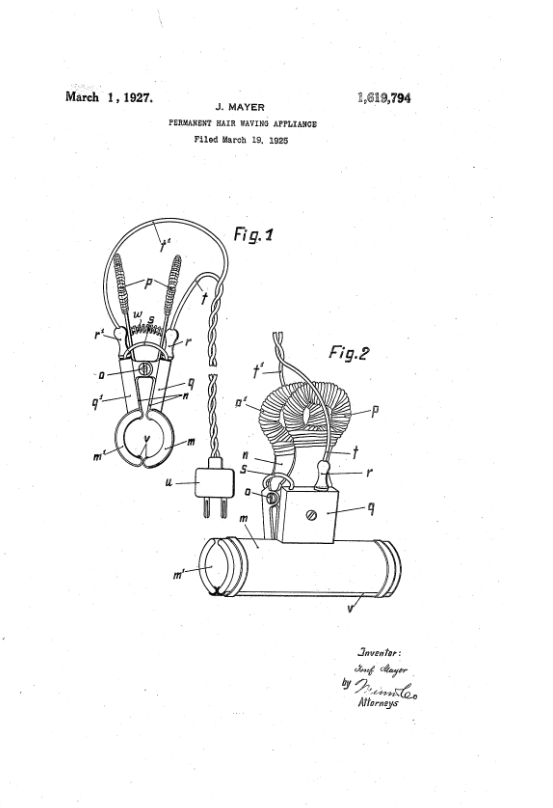
Legible 1927 patent drawing by Josef Mayer showing the heated appliance and hair curler
Josef Mayer, 1927. A lateral-opening heating appliance for flat-wound hair. US 1,619,794. Original patent and claims.

Marjorie Stewart Joyner, 1928

Her patent drawing documents a different problem: suspending and arranging heated irons around the head while providing scalp protection.

View original patent drawings and claims ↗

US 1,693,515 · 27 November 1928

Inventors, systems and approaches

What was each person trying to solve?

Foundational process · 1906

Karl Ludwig Nessler

The problem: How can a wave remain after the treatment?

The approach: Combined winding, chemical preparation and electrically supplied heat into a demonstrated permanent-waving process.

Demonstrated approach

Explore the research chapter ↗

Heating · 1910s

Eugène François Suter

The problem: Can heat be applied more selectively?

The approach: Explore designs that separate or vary heating zones. The precise claim must be read from the original specification before describing performance improvements.

Patent comparison needed

Explore the research chapter ↗

Heating & manufacture · Early 20th century

Isidoro Calvete / Icall

The problem: How can heating apparatus be made and supplied for salons?

The approach: Investigate heating-unit construction and manufacturer relationships. Production of an apparatus is not automatically evidence of a new patentable principle.

Attribution unresolved

Explore the research chapter ↗

Competing apparatus · Early 20th century

Gallia

The problem: Could another machine arrangement make salon work easier?

The approach: A reported competing European system. Its precise distinctive construction, dates and inventor attribution require original trade or patent evidence.

Attribution unresolved

Explore the research chapter ↗

Competing practice · Early 20th century

Étienne Szeemann

The problem: How should winding and heat be organised in the salon?

The approach: A research lead in early European permanent waving. Do not yet assert a specific heat-regulation innovation without technical documentation.

Attribution unresolved

Explore the research chapter ↗

Winding · 1920s onward

Croquignole method

The problem: How can shorter hair be wound effectively?

The approach: Winding from the tips toward the scalp, unlike root-first spiral winding; a procedural approach associated with multiple historical contributors.

Method, not single machine

Explore the research chapter ↗

Commercial systems · 20th century

Charles Frederics

The problem: How did branded equipment and salon supply change adoption?

The approach: Investigate apparatus models, training, advertising and distribution separately from the claims of technical invention.

Commercial evidence needed

Explore the research chapter ↗

Chemistry · 20th century

Cold-wave systems / Willatt

The problem: Can a lasting wave be achieved without a large heated machine?

The approach: Chemical cold-wave approaches altered the balance between external heat, processing chemistry and equipment.

Different technical pathway

Explore the research chapter ↗

Electronic control · Contemporary

Digital perm

The problem: Can heated-rod treatment be controlled electronically?

The approach: Electrically heated rods, chemical treatment and electronic temperature control show a recurring technical combination, not a proven direct descent.

Modern comparison

Explore the research chapter ↗

Winding: changing the shape of the treatment

Winding is not simply a preliminary step. The geometry of the hair on the rod affects which lengths can be treated and which heating apparatus will fit. Croquignole winding and Mayer’s lateral-opening heater therefore belong together as a question of procedure and equipment, without implying that Mayer invented all end-to-root winding.

Winding techniques and Josef Mayer ↗

Heating: a question of distribution and control

Later inventors and manufacturers explored heating-element designs, temperature application and the handling of electrical equipment. For Suter and Calvete, we must identify the precise apparatus and patent claims before stating that one design was objectively safer, lighter or more efficient.

Early competing systems ↗

Apparatus: supporting the work

Joyner’s patent is a clear example of innovation in machine arrangement: the supporting dome and suspension address the practical challenge of positioning multiple heated devices. This is a different problem from Mayer’s flat-winding heater.

Machine design and salon equipment ↗

Chemistry: a new branch, not a final model

Chemical cold-wave systems changed the relationship between hair treatment and large electrical heating machines. Modern digital perms, in turn, combine chemistry with electronically controlled heat. This is a comparison of principles, not a documented unbroken line of descent.

Chemical cold wave ↗ · Modern digital perm ↗

Next evidence needed: original apparatus images and contemporary catalogues for Gallia, Szeemann, Calvete and Frederics; full technical patent comparisons for Suter; dated commercial records for the distribution of individual systems. These are research gaps, not established facts.

Evidence crosswalk: what each source can establish

These are evidence categories, not rankings of inventors. The same technology can be represented by different types of documents.

CaseSource availableWhat it supportsWhat it does not establish
Josef MayerUS 1,619,794 (1927)Disclosed heater construction and patent claimsInvention of all flat winding; commercial adoption
Marjorie Stewart JoynerUS 1,693,515 (1928)Disclosed support and arrangement of heating devicesSales volume or priority over every earlier salon apparatus
Eugène François SuterGB 111372 and US 1,266,879 · examine claimsPatent-document leads requiring close technical readingWhich exact features reached production or were widely used
Calvete / IcallHistorical image and provenance leadAppearance of an identified apparatus, subject to provenance reviewIndependent invention or exact manufacturing dates
Gallia / SzeemannFurther original documentation neededCurrent research questionsSpecific patent claims or technical priority
Methodological rule: A patent is evidence of what was disclosed and claimed; a photograph documents an object or representation; an advertisement documents a commercial claim. None alone proves widespread use or direct influence between inventors.

Open the full evidence register → · Read the historical overview →

Evidence register

To keep the research transparent, our working evidence register distinguishes an original patent from a company name, a retrospective account or an unverified technical claim.

Open the evidence register →