Hairdressing history cannot be explained through inventions alone. It also depends on people: hairdressers, teachers, technicians, manufacturers, travelling demonstrators, publishers and customers. Their professional relationships help explain how new techniques became known and adopted.
Biography and context
A biography should reconstruct where a person worked, with whom they collaborated and how their activities can be documented. Claims of being “first” require particular caution.
Networks and circulation
Professional knowledge circulated through travel, salons, schools, trade fairs, demonstrations, patents, commercial representatives and specialist publications. These connections are often as historically important as the invention itself.
Research directory
People, inventions and professional networks
Hairdressing history was shaped by inventors, salon practitioners, educators, manufacturers and publishers. Explore documented technical contributions and the historical evidence behind each profile. A patent is not, by itself, proof of commercial success.
Compare two patented machines → · Explore the Innovation Atlas → · Evidence register →
Research guide · evidence before attribution
People, contributions and primary evidence
The history of hairdressing developed through overlapping inventions, salon practices, teaching, manufacturing and trade. These profiles distinguish a documented technical contribution from an unverified claim of priority. A patent documents what was disclosed and claimed; it does not by itself prove manufacture or widespread salon use.
Marcel Grateau
Field: temporary heat-set waving with heated tongs. The Marcel wave is a precursor in styling practice, not itself a chemical permanent wave.
Evidence to pursue: contemporary advertisements, training manuals and dated apparatus descriptions.
Read the existing profile ↓
Charles Nessler (Karl Ludwig Nessler)
Field: early permanent waving using winding, chemical treatment and applied heat; public demonstration in London in 1906.
Evidence to pursue: dated trade reporting, patents, commercial records and training material.
Explore the Nessler system →
Josef Mayer
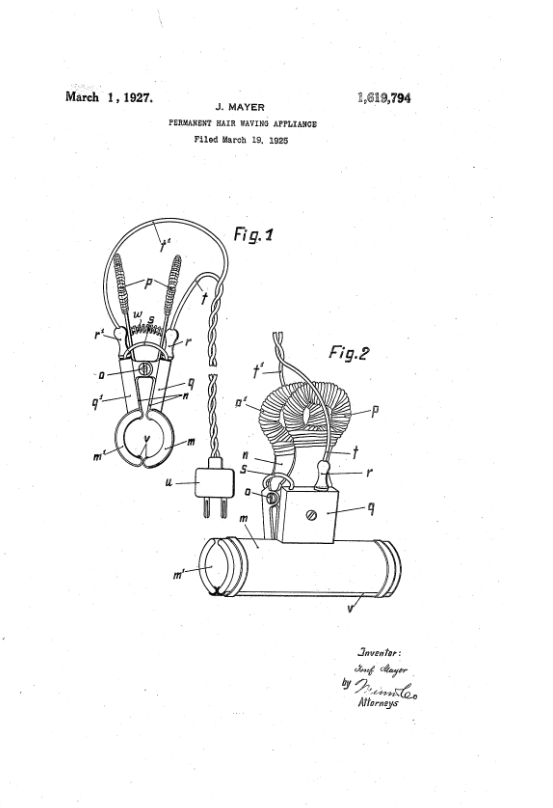
Field: patent-documented heating apparatus associated with a flat-wound arrangement. US 1,619,794 was filed 19 March 1925 and granted 1 March 1927.
Primary source: US 1,619,794.
Compare the patents →
Marjorie Stewart Joyner
Field: a patented arrangement for supporting and positioning multiple hair-waving appliances, with attention to operation and protection. US 1,693,515 was granted 27 November 1928.
Primary source: US 1,693,515.
Study machine design →
Eugène François Suter
Field: patented developments in permanent-wave apparatus. His historical role should be examined through the precise patent claims rather than broad statements about who invented the permanent wave.
Primary sources: GB 111372 and US 1,266,879.
Early competing systems →
Arnold F. Willatt
Field: commonly associated with the development of the chemical cold-wave process. Exact priority, formulation and commercial chronology require independent documentary verification.
Evidence to pursue: dated patent filings, chemical specifications and contemporary trade coverage.
Explore chemical cold waving →
Open dossiers: Gallia, Étienne Szeemann and Isidoro Calvete / Icall are documented or reported in different ways, but invention, manufacture and professional association must not be conflated. Their profiles remain provisional until more primary records are verified.
View the research status →
Research profiles
- Karl Ludwig (Charles) Nessler (1872–1951): a central figure in the development and international commercialisation of permanent waving; his dedicated biographical research remains on the Nessler websites.
- Mayer and Gallica: names connected with our wider investigation of early permanent-wave techniques. Their individual roles and chronology will be presented only as documentary evidence is assembled and checked.
- Other pioneers: the scope extends to lesser-known inventors, skilled workers, women in the trade, manufacturers and professional educators.
How a network is reconstructed
- Contemporary trade directories, advertisements and journal reports can establish names, addresses and business relationships.
- Passenger lists, residence records, company registers and patents can help place individuals in time and space.
- An advertisement proves that a claim was published; it does not automatically prove the claim was accurate.
Charles Nessler: a documented international career
From the Black Forest to Britain
Karl Ludwig Nessler was born in Todtnau in 1872. His early movements through Switzerland and his later career in London demonstrate why regional, national and international records must be read together.
Public demonstration and invention
The London demonstration of 8 October 1906 is a key event. Historical priority claims must be assessed with contemporary publications, patent chronology and evidence of actual use.
The American chapter
Nessler entered the United States in January 1915. His later patents and the Nestlé-LeMur business context show that his story is also one of industrial organisation and transatlantic circulation.
Mayer and Gallica: research profiles in progress
J. Mayer
The archival register includes US patent 1,619,794, “Permanent Hair Waving Appliance” (filed 1925, granted 1927). A full profile requires confirming the inventor’s identity, other patents, commercial associations and actual production.
Gallica
Gallica belongs among the names to investigate in early permanent-wave history, but a reliable biographical profile needs contemporary documentation. We do not yet assign unverified dates, patent priority or commercial achievements.
Beyond famous inventors
Technicians, salon owners, demonstrators, teachers, distributors and clients helped transform inventions into everyday professional practice. They deserve attention even where the surviving record is fragmentary.
Reconstructing networks responsibly
A dated evidence trail
Passenger lists, address books, trade journals, company registrations, patents and correspondence can establish where individuals worked and whom they encountered.
Separating relationships from coincidence
Two names appearing in the same city or trade publication does not prove a professional partnership. Links should be classified as documented, probable or still hypothetical.
Transnational comparison
London, Paris, Berlin, Switzerland and the United States provide overlapping contexts. Chronological maps and source-based profiles can show movement without implying a single linear story.
Questions for future profiles
- Who trained whom, and where?
- Which practitioners carried techniques from one country to another?
- Where do later biographical narratives differ from contemporary records?
Research status. This page is an introductory research overview, not a completed scholarly catalogue. Illustrations are design placeholders, not authenticated historical photographs or evidence. Specific claims will be documented with dated primary sources as the collection develops.
Related researchExplore the sources and projects
Marjorie Stewart Joyner (1896–1994): inventor and educator
Marjorie Stewart Joyner was an American hairdresser, salon owner, inventor and beauty-industry educator. She trained in Chicago and developed a career connected with the Madam C. J. Walker Manufacturing Company and its professional training network.
Professional training and leadership
Joyner graduated from the A. B. Moler Beauty and Culture School in Chicago in 1916. She subsequently developed expertise through the Walker organisation, where she held leadership responsibilities in beauty education. Her career is part of a wider history of Black women’s entrepreneurship, vocational training and professional organisation in the United States.
Her 1928 invention
Joyner filed her application for a Permanent Waving Machine on 16 May 1928; US Patent 1,693,515 was issued on 27 November. The patent names Joyner as inventor and assigns the rights to the Madam C. J. Walker Manufacturing Company. Its design incorporates a suspended group of heated curling irons and devices intended to support their weight and protect the scalp.
Evidence beyond the patent
The Smithsonian preserves curling rods used by Joyner in her Chicago salon, material evidence of her long professional practice. Its exhibition also documents her role in training thousands of Black beauticians. The history of the patent’s commercial distribution, however, should be researched separately.
Sources: US Patent 1,693,515 · Smithsonian: Marjorie Stewart Joyner · Smithsonian collection: permanent rod used by Joyner.
Compare Mayer and Joyner: different engineering problems →
RESEARCH PROFILE · FRANCEMarcel Grateau: an innovator of temporary thermal waving
The existing biographical research identifies Marcel Grateau (1852–1936) as the French hairdresser associated with the Marcel wave, a heat-styling method commonly dated to the early 1870s. Accounts of his career connect the technique to Parisian salon culture and the professionalisation of controlled tong waving.
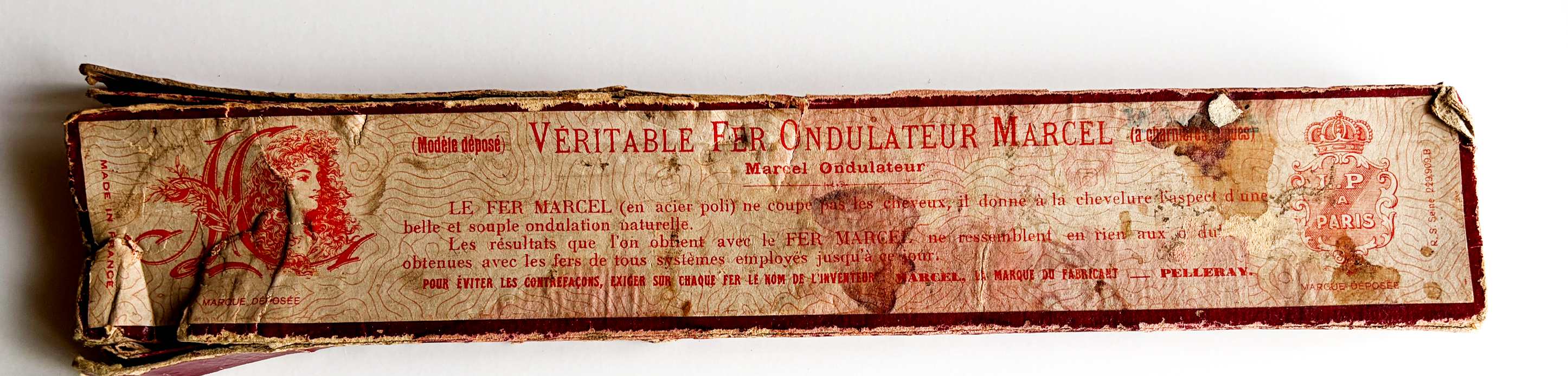
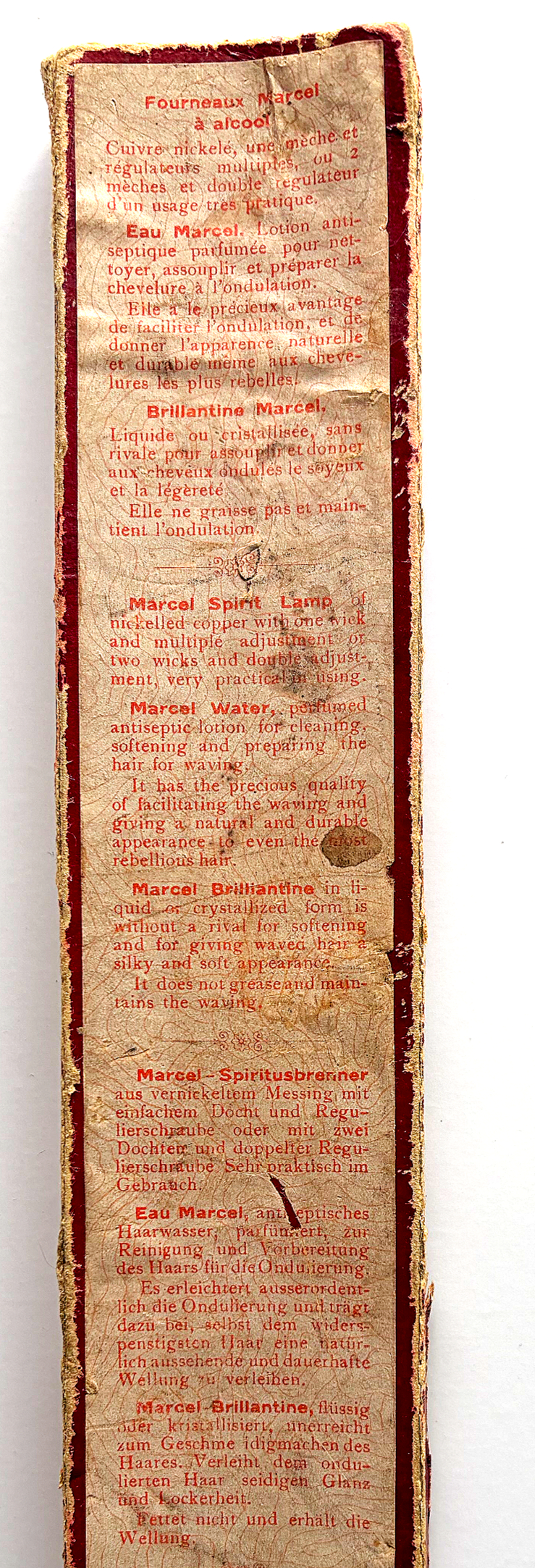
Grateau’s achievement should not be confused with Nessler’s later permanent-wave process. The historical distinction is not merely chronological: it concerns the mechanism, duration and practical use of the treatment. The surviving commercial package pictured here illustrates the subsequent marketing of Marcel-style implements, not necessarily an object made by Grateau himself.
Compare the technologies and examine the historical object.
RESEARCH PROFILE · CENTRAL EUROPEJosef Mayer (1881–1952): the international hairdresser behind flat winding
According to the project’s biographical research, Josef Mayer was born on 6 February 1881 in Parabutsch (Parabuć), then in the Kingdom of Hungary. His professional path included Budapest, Vienna and several European cities, followed by a salon career in Karlsbad (Karlovy Vary). The research associates his experiments with flat winding with the winter of 1923–1924.
The patent record provides a firmer technical anchor: US 1,619,794 identifies Josef Mayer of Karlsbad, Czechoslovakia and describes an electrically heated appliance designed for flat strands of hair. The distinction between the biography and the dated patent is important: travel, prizes, teaching credentials and commercial networks require their own corroborating contemporary records.
Primary source: US 1,619,794 (1927). Read the technical analysis.
Compare Mayer and Joyner: different engineering problems →
Continue exploringOther research collections
CROSS-COLLECTION RESEARCHComparative technical systems
The Technology & Patents collection now contains a detailed, evidence-labelled catalogue of Nessler, Gallia, Szeemann, Suter, Calvete, Croquignole, Frederics, Mayer and Joyner, alongside the distinct Marcel method. Explore the comparative catalogue →
Explore the wider research collection
This subject is part of a larger, interconnected reference project covering the history of hairdressing—not only permanent waving or one inventor.