Professional journals and advertising reveal how hairdressing became an increasingly connected industry. They record technical claims, training opportunities, product launches, professional debates and the emergence of international markets.
Trade journals as sources
A trade journal can preserve dated evidence of demonstrations, products, salons, organisations and personalities. Its articles, advertisements and editorial positions must nevertheless be read in their commercial and historical context.
Companies and markets
Manufacturers, wholesalers and salon suppliers transformed techniques into products and services. Company histories reveal distribution, branding, training and the relationship between local workshops and international businesses.
Research directory
The professional press and the hairdressing industry
Patents show what inventors claimed. Trade journals, catalogues, advertisements and company records help us investigate what practitioners learned, manufacturers offered and salons actually adopted. Each source answers a different historical question.
Technology & Patents → · Pioneers & People → · Evidence register →
How to interpret industry sources
Patent: establishes the content of a filed or granted technical claim. Advertisement: establishes that a product or claim was publicly promoted in a particular issue. Catalogue: documents an offered product range at a stated date. Company record: may establish production, distribution or sales when the document actually contains those details. None of these alone proves that an invention was widely adopted.
Consult the project evidence register →
What we examine
- Specialist periodicals and their geographic circulation, editorial focus and advertising markets.
- Advertisements for waving machines, preparations, hairpieces, tools and training.
- Manufacturer catalogues, business records, patents and trademarks.
- Trade associations, exhibitions, training institutions and commercial networks.
From advertisement to historical evidence
- An advertisement is evidence that a company made a particular statement at a particular time. It is not independent proof that the advertised performance or claimed priority was true.
- Comparing dated advertisements with patents, surviving objects, corporate records and reports can help reconstruct product development and commercial reach.
- Where only a scan or a later transcription survives, provenance and uncertainty should be made explicit.
Trade journals as historical evidence
Professional knowledge in print
Trade journals circulated technical instructions, salon reports, advertisements, debates, product announcements and accounts of demonstrations. Their intended professional audience shaped what they chose to publish.
A London point of reference
The Hairdressers’ Weekly Journal of October 1906 is an important lead for examining contemporary reporting around Nessler’s London demonstration. Original wording and page context should be checked before quotation.
Reading across languages
English, German and French periodicals can describe the same invention differently. Comparing terminology, dates and images helps identify transmission, translation and marketing changes.
Companies, products and markets
From invention to distribution
Manufacturers, wholesalers, training schools and salons connected technical developments to consumers. Patents alone cannot reveal the scale of this commercial network.
Nestlé-LeMur
The 1928 combination of C. Nestle and Le Mur offers a case study in company history, brands, product portfolios and the American beauty industry. Individual product claims should be tied to dated advertisements or catalogues.
Advertising as evidence
An advertisement can document a name, claim, date, price, address or visual representation. It cannot by itself prove the claimed effectiveness, market dominance or invention priority.
A method for describing periodicals
Bibliographic record
Record the exact title, issue date, volume, page, publication place, language and holding institution.
Item-level evidence
Describe the article or advertisement separately from the journal issue; transcribe names, product marks and dates exactly, preserving uncertainties.
Rights and access
Distinguish public-domain sources, licensed reproductions, excerpts and bibliographic references. Link to institutional holdings where full reproduction is not authorised.
Questions for future research
Trade routes
Which wholesalers and trade fairs carried apparatuses and products between European and American markets?
Professional training
How did certificates, demonstrations and schools standardise new techniques?
Industry comparison
What can company registers, product catalogues and surviving advertisements reveal that biographies cannot?
Selected source leads and bibliographic references
- Hair & Beauty Science: A Journal for the Development of the Profession, vol. 1 (1928). Google Books catalogue and preview.
- U.S. Department of Labor, Women's Bureau, Employment Opportunities for Women in Beauty Service, Bulletin 260 (1956). A later government survey, useful for historical context rather than direct proof of events in 1906. Read the report.
- Library of Congress, Ellen Terrell, Charles Nessler, Inventor and Hair Entrepreneur (24 June 2022). A secondary overview with references to patents and contemporary newspapers. Read the article.
- The Basic Science of Hair Treatments, Nestlé-LeMur Company (New York, 1935), described in the Nestlé-LeMur historical documents collection. Company training material; editorial independence should not be presumed.
Research leads still requiring page-level verification: Hairdressers’ Weekly Journal (London demonstration reporting, October 1906); La Coiffure de Paris (1909); Wiener Friseurzeitung (1 November 1923). No unverified page numbers are supplied.
Tracing an innovation across borders
To follow an innovation from a demonstration to professional use, compare dated reports in several countries. Record the original language, distinguish a translation from an independent report, and track changes in the product name. A single advertising campaign can generate many apparently separate references.
For example, a British advertisement for a permanent-wave service, a continental trade notice announcing a demonstration and an American company training manual answer different questions. Only when dates, organisations and technical descriptions align can a cautious account of international transmission be proposed.
Permanent-wave history → · Technology & patents → · Evidence register →
From a printed claim to historical evidence
| Source type | What it can show | What it cannot establish alone |
|---|
| Trade-journal report | What was reported to a professional readership at a given time | Whether every described result was independently verified |
| Paid advertisement | Brand names, prices, addresses and promotional claims at publication date | Actual sales, technical effectiveness or broad adoption |
| Patent specification | The inventor's disclosed construction and legally stated claims | Manufacture, commercial success or exclusive historical priority |
| Manufacturer catalogue | Offered models, accessories and technical descriptions | How many machines were sold or installed |
| Instruction book / training text | What learners or practitioners were instructed to do | Whether practice was uniform across countries and salons |
| Company accounts / registers | Legal entities, dated transactions and sometimes scale of activity | All the details of salon-level practice |
International research catalogue · selected examples
Historical periodicals and professional publications
A journal's name, date and place of publication provide a starting point, not a complete history. The entries below distinguish periodicals from individual articles and company training publications. Their inclusion does not mean that all issues have been examined.
United Kingdom · trade periodical
Hairdressers’ Weekly Journal
A British professional trade periodical useful for studying salon practices, trade organisations, advertising and debates over new techniques. Reports associated with the London permanent-wave demonstrations of 1906 warrant direct consultation of the dated original issues.
Research task: establish the exact issue, page and wording for each cited report; avoid treating later retellings as transcripts.
France · professional press
La Coiffure de Paris
A French-language point of comparison for technical reporting, professional fashions and cross-border circulation. An identified 1909 reference to foreign developments is a research lead, not yet a complete item-level citation on this page.
Research task: record issue, page, publisher and original wording from the scan.
Austria · professional press
Wiener Friseurzeitung
A source for German-language professional discussion and training announcements. A notice dated 1 November 1923 concerning a Nestlé permanent-wave event offers a test case for documenting how a technique circulated.
Research task: verify the issue and page, then distinguish a scheduled demonstration from evidence that it actually took place.
United States · scientific-professional publication
Hair & Beauty Science (1928)
Hair & Beauty Science: A Journal for the Development of the Profession, volume 1, is bibliographically documented for 1928. Its contents and contributors can help trace claims about scientific hair treatment and professional education.
View bibliographic record and digitised preview ↗
Editorial rule: A periodical listing confirms a publication's existence only to the extent supported by its catalogue record. It does not by itself verify a particular invention, an article's claims or the number of salons using a product.
Research directions
- How did innovations move between European and American markets?
- Which publications acted as meeting places for inventors, teachers and manufacturers?
- How did the rise of branded products and professional education reshape the salon?
Research status. This page is an introductory research overview, not a completed scholarly catalogue. Illustrations are design placeholders, not authenticated historical photographs or evidence. Specific claims will be documented with dated primary sources as the collection develops.
Related researchExplore the sources and projects
Joyner’s 1928 patent: tracing an invention through the beauty industry
Marjorie Stewart Joyner’s patent offers a documented starting point for studying the relationship between hairdressing inventions, vocational education and the American beauty business. The application was filed in May 1928 and the patent granted in November of that year.
Different records answer different questions
Patent specifications establish the inventor, assignee, claims and illustrated mechanism. Trade journals and advertisements may show how equipment was marketed. Training manuals and school records can demonstrate what practitioners were taught. Surviving salon equipment can reveal actual use. These categories should not be treated as interchangeable evidence.
The Walker network
Joyner’s professional association with the Madam C. J. Walker Manufacturing Company makes its schools, commercial publications and professional contacts important leads. The Smithsonian documents her significant training role; evidence for the particular machine’s distribution must still be identified in contemporary sources.
Open archival questions
Can we locate a dated advertisement for the patented apparatus? Was it sold under a particular trade name? Do school manuals or salon photographs show the exact patented configuration? These questions remain open until contemporary documentation is found.
Source trail: US Patent 1,693,515 · National Archives patent drawings · Smithsonian historical context.
RESEARCH METHOD · ADVERTISING AND PATENTSHow a technique becomes a product: Grateau, Mayer and the permanent wave
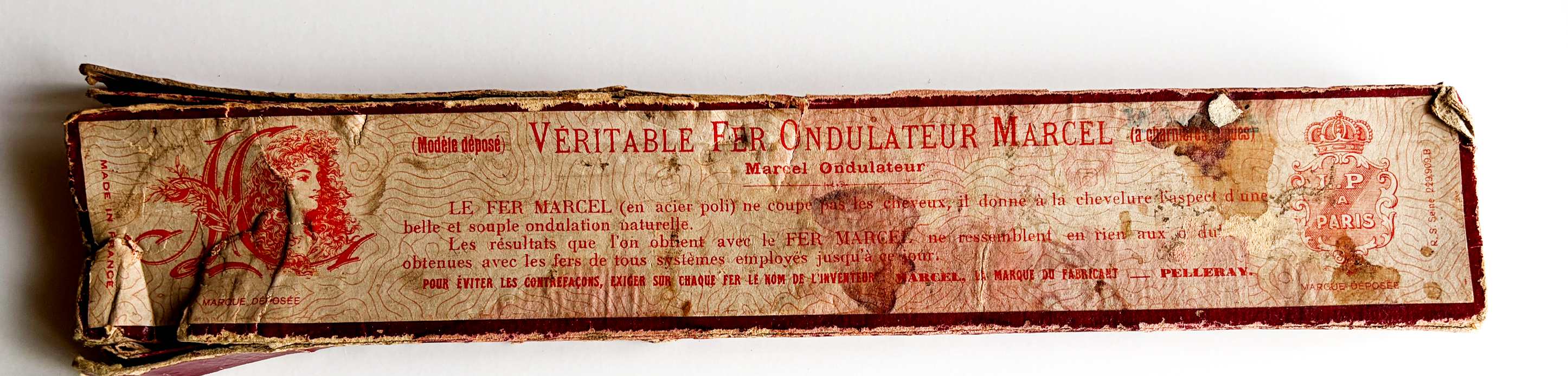
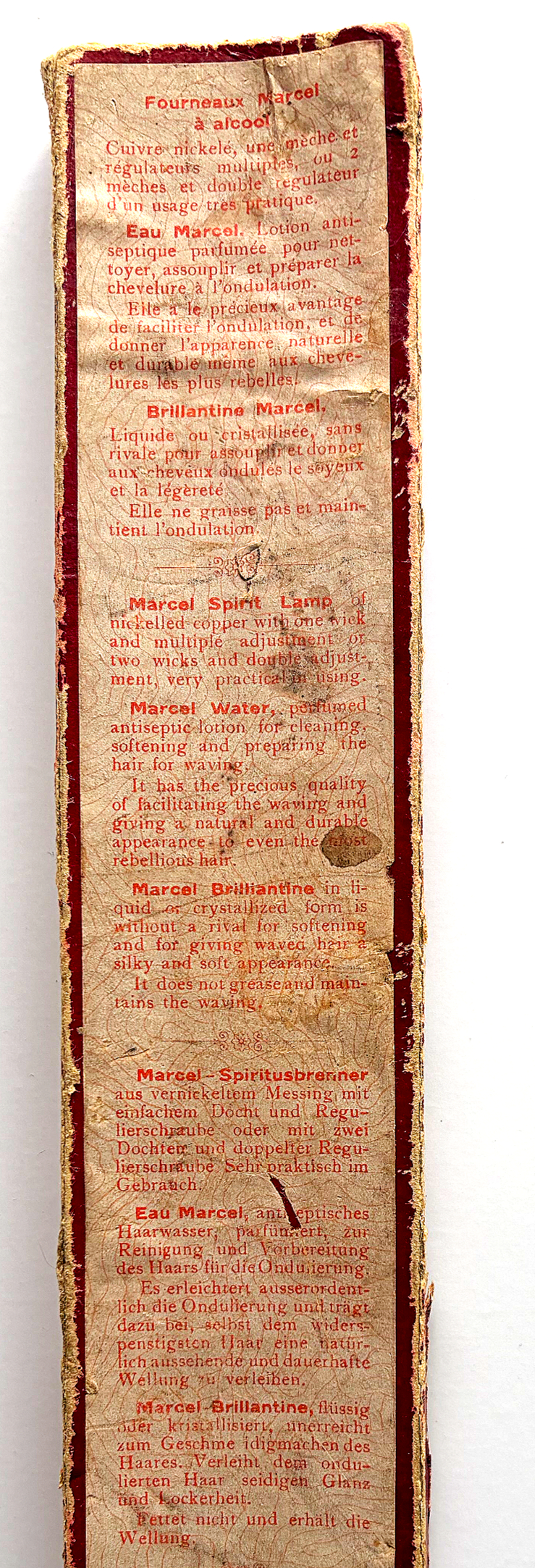
The packaging for a Marcel-style ondulation iron is an example of object evidence: it shows how a named technique could be presented and explained to purchasers. To establish a date, distribution network or original manufacturer, it must be paired with catalogues, trade advertisements and surviving business records.
Josef Mayer and patent-to-market research
US Patent 1,619,794 establishes a particular technical design in 1927, not how many units were sold. Contemporary advertisements for Mayer Realistic, catalogues, professional teaching material and company registrations are the appropriate next sources for commercial history.
International comparison
The project’s existing survey identifies further systems associated with Gallia, Szeemann, Suter, Calvete, Frederics, Racine and Willatt. For each, the research record should separate the inventor, company or trade name, patent dates, advertised claims and evidence of actual salon use. This prevents later accounts from turning commercial language into unsupported invention priorities.
See the illustrated technical timeline and the Mayer research profile.
Continue exploringOther research collections
CROSS-COLLECTION RESEARCHComparative technical systems
The Technology & Patents collection now contains a detailed, evidence-labelled catalogue of Nessler, Gallia, Szeemann, Suter, Calvete, Croquignole, Frederics, Mayer and Joyner, alongside the distinct Marcel method. Explore the comparative catalogue →
Explore the wider research collection
This subject is part of a larger, interconnected reference project covering the history of hairdressing—not only permanent waving or one inventor.