International
Hairdressing History ProjectIndependent Archival Research Initiative
Research Collection · Tools & Materials

Mirrors, Combs and Brushes

Three everyday objects, many centuries of craft, industry and social history.

← All research collections
Illustrative historical-style image for Tools & Materials; design placeholder, not an archival record

A mirror, a comb and a brush are so familiar that their history is easily overlooked. Yet each object brings together raw materials, specialist workshops, changing fashions, trade routes and the everyday routines of hairdressers and their clients.

Collection guide

Explore tools, materials and the craft behind them

From everyday workshop objects to specialised electrical equipment: follow the material, manufacturing technique, working practice and surviving historical evidence.

The mirror

Mirrors shaped the arrangement of salons and the relationship between practitioner and client. Their history involves glassmaking, reflective coatings, furniture, lighting and the changing experience of seeing oneself.

The comb and the brush

Combs and brushes served different functions: separating, arranging, detangling, cleaning and finishing hair. Their forms depend on materials, methods of manufacture and the work for which they were designed.

Three objects, three histories

Object-based research · Technical history

How to read a historical hairdressing tool

A surviving object tells us something different from an advertisement or a patent. The object can reveal materials, dimensions, wear and construction; a patent records a disclosed technical proposal; trade literature may establish marketing claims and intended users. None alone proves widespread adoption.

Heated waving irons

Compare tong shape, handle insulation, heat source and the hair arrangement. Marcel waving used heated irons to create temporary waves; it was not itself a permanent-wave chemical process.

Permanent-wave history →

Combs and brushes

Study tooth or bristle arrangement, handle materials, manufacturing marks and repair traces. Patent evidence can document innovations, but individual dates of invention require verification.

Explore the comb collection ↓

Mirrors and salon furniture

Investigate glass production, reflective coatings, furniture, illumination and the social arrangement of the salon. Separate the history of manufacture from the history of salon use.

Explore the mirror collection ↓

Permanent-wave apparatus

Heating elements, rods, suspension arms and scalp protection must be understood as parts of a working system rather than as interchangeable inventions.

Machine design →

Suggested catalogue fields

Object / manufacturer · approximate date · place · material · measurements · inscriptions · mechanism · provenance · image rights · primary source · confidence level. Record uncertain identifications as such rather than converting them into definite attributions.

Research leads: Lyda D. Newman’s US 614,335 (1898) is a useful patent starting point for brush history; contemporary catalogues and surviving examples are needed to assess manufacture and use. Read the patent →

The workshop behind the object

The mirror: manufacture and meaning

From reflective surfaces to modern mirrors

The history of mirrors involves changes in glassmaking, metal coatings and workshop techniques. Historical silvered and mercury-based mirrors require careful distinction; their production and conservation raise different technical and health questions.

The salon mirror

A mirror was more than a domestic accessory: its placement affected lighting, the customer’s view, the working position of the hairdresser and the design of the salon. Photographs and equipment catalogues can document these arrangements.

Research material

Historical literature on silvering and mercury mirrors provides technical context. Individual claims about dates, manufacturers or inventions must be checked against the original editions.

The comb: material, craft and industry

Material transitions

Horn, bone, wood, tortoiseshell, hard rubber and early plastics belong to different production traditions. Their chronology varies by region and market; no single material replaced all others at once.

Making a comb

Sawing, cutting teeth, shaping, polishing and finishing can be examined through tools, factory records, patents and surviving objects. The width and spacing of teeth also reflect different uses.

A Swiss research connection

The history of comb manufacture in Mümliswil offers a possible comparative case for the industrial and regional study of comb-making. Specific company and production claims require individual source references.

The brush: from workshop to factory

Materials and construction

A brush combines a handle or stock, bristles or other fibres, and a method of fastening. Material selection and the arrangement of bristles help distinguish manufacture and intended use.

Regional manufacturing

The Todtnau area and the wider Black Forest offer important leads for brush-making history. Local craft traditions, factory development and specialist machinery should be investigated through municipal and company archives.

Machines and patents

Historical brush-making machinery and firms such as Zahoransky open a path into mechanisation. Dates of particular machines and technical milestones must be supported by original company records, patents or catalogues.

Shared questions for the three objects

Who made them?

Identify workshops, manufacturers, suppliers and trade routes rather than treating the objects as anonymous accessories.

Who used them?

Compare professional salon equipment with domestic objects, considering price, hygiene, fashion, gender and working conditions.

What survives?

Bring together museum objects, makers’ marks, catalogues, advertisements, photographs and patents, with clear provenance.

Questions for the collection

Research status. This page is an introductory research overview, not a completed scholarly catalogue. Illustrations are design placeholders, not authenticated historical photographs or evidence. Specific claims will be documented with dated primary sources as the collection develops.
Related research

Explore the sources and projects

Salon tools and specialised apparatus

Mirrors, combs and brushes were everyday working tools; permanent-waving machines belonged to a different category of specialised equipment. Studying their use together can nevertheless illuminate the organisation of a salon and the changing relationship between manual skill and mechanical apparatus.

Marjorie Stewart Joyner’s 1928 design is an example: its overhead dome supported several electrically heated curling irons, while separate clamps reduced the weight borne by the client’s hair. The patent also illustrated scalp protection during winding.

See the full English-language discussions in Technology & Patents and Pioneers & People, and consult the original US patent and drawings.
OBJECT STUDY · HEATED TONGS

The Marcel iron: an object, a method and a market

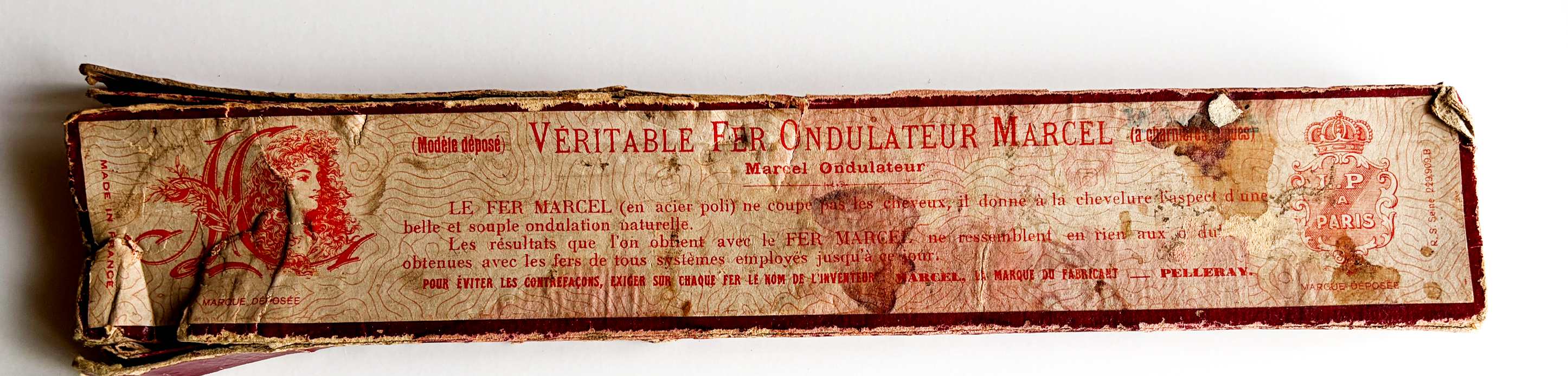
Historical French packaging for a Marcel ondulation iron, front
Historical object: front of packaging. Marcel ondulation iron. Photograph of a surviving historical package, reproduced from the project’s existing collection. Dating and manufacturer attribution require examination of the object.
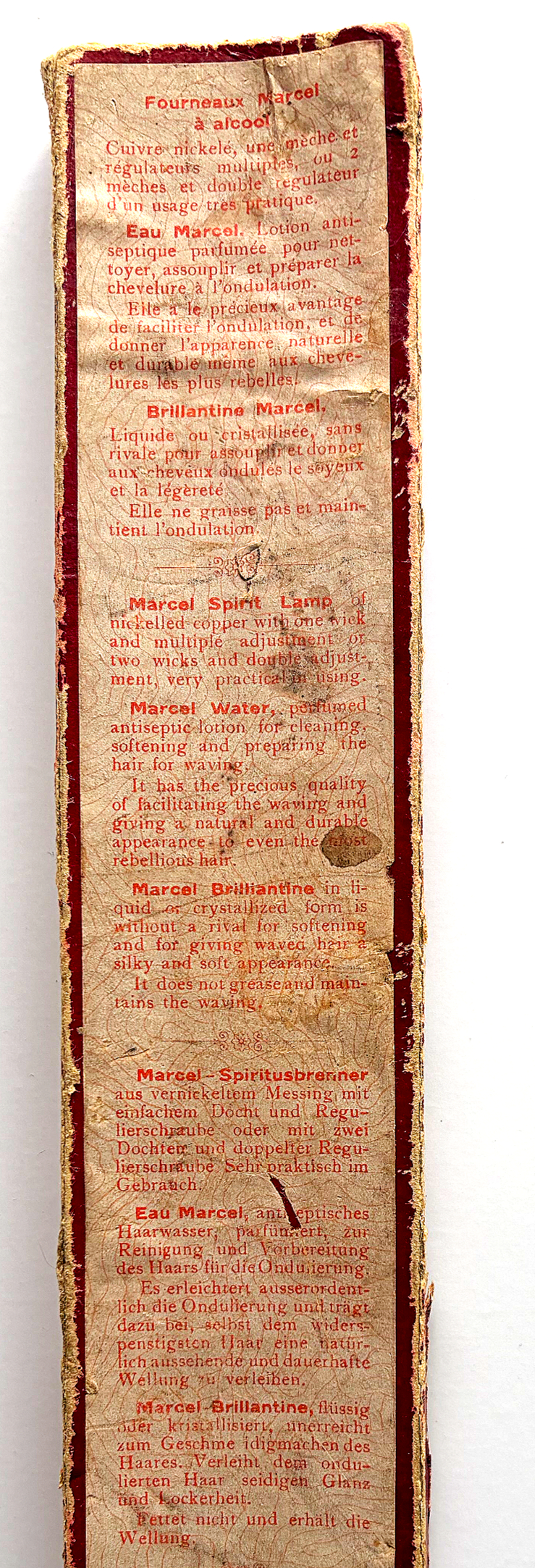
Back of historical Marcel ondulation iron packaging showing multilingual printed instructions
Reverse of packaging. Printed instructions and product information illustrate how a styling technique became a marketed object. Photograph of a surviving historical package, reproduced from the project’s existing collection. Dating and manufacturer attribution require examination of the object.

Marcel waving illustrates why an implement must be studied alongside the hand technique used with it. Heated tongs did not produce the wave automatically: temperature, pressure, direction and timing were all matters of professional skill.

What the packaging can tell us

The surviving package offers evidence of product presentation and printed directions. Its language, manufacturer’s marks and construction should be transcribed and compared with dated advertisements before assigning a production date. It is not itself a patent for the original invention.

For the distinction between temporary thermal waving and permanent chemical waving, see Technology & Patents: Marcel Grateau. The patented electric heater for flat winding is examined separately under Josef Mayer.

Continue exploring

Other research collections

CROSS-COLLECTION RESEARCH

Comparative technical systems

The Technology & Patents collection now contains a detailed, evidence-labelled catalogue of Nessler, Gallia, Szeemann, Suter, Calvete, Croquignole, Frederics, Mayer and Joyner, alongside the distinct Marcel method. Explore the comparative catalogue →

Explore the wider research collection

This subject is part of a larger, interconnected reference project covering the history of hairdressing—not only permanent waving or one inventor.

Permanent wave historyFrom heated tongs and Nessler’s process to later developmentsInventors and pioneersMarcel Grateau, Nessler, Mayer, Joyner and othersPatents and technologyHow machines, heating and winding techniques changedChemical cold waveChemical approaches and the transition away from large heated apparatusTools and salon practiceCombs, brushes, mirrors, instruments and professional workTrade journals and sourcesOriginal trade press, evidence and professional networksInnovation atlasCompare the engineering problems behind inventionsDevelopment treeExplore competing and parallel technical branchesEvidence registerWhat is documented, and what still needs research